

What Is Sleep Paralysis?
Sleep paralysis is a temporary inability to move or speak that occurs when your brain wakes up before your body during the sleep-wake transition.
In simple terms, sleep paralysis happens when you become consciously aware while your body remains in a state of muscle atonia, the natural muscle relaxation that occurs during REM sleep. This creates a brief period of temporary immobility, even though you feel awake.
Sleep Paralysis Explained
Sleep paralysis is classified as a parasomnia, which means it is an unusual event that happens during sleep. It typically occurs during two key stages –
- Hypnagogia – the transition from wakefulness to sleep
- Hypnopompia – the transition from sleep to wakefulness
During these transitions, your brain can partially awaken while your body is still in the dream state overlap of REM sleep. This mismatch between brain activity and muscle control causes the sensation of being awake but unable to move.
Why Sleep Paralysis Feels Terrifying
Sleep paralysis often feels frightening because it combines three intense elements –
- Conscious awareness – You know you are awake.
- Temporary immobility – You cannot move or speak.
- Dream imagery intrusion – REM-related dream activity may continue, causing vivid hallucinations or a sense of presence.
The overlap of REM sleep and partial awakening can produce visual, auditory, or tactile hallucinations. Many people report seeing shadowy figures, hearing voices, or feeling pressure on the chest. These sensations are caused by ongoing REM brain activity, not by external threats.
Where It Fits in the Sleep Cycle
The normal sleep cycle includes four stages – three non-REM stages and one REM stage. During REM sleep –
- Brain activity increases
- Dreams become vivid
- Muscle atonia prevents physical movement
Sleep paralysis occurs when REM muscle atonia continues after conscious awareness returns.
Is Sleep Paralysis Dangerous?
Sleep paralysis is usually harmless and not physically dangerous. Episodes typically last from a few seconds to 2 minutes. Although the experience feels intense, it does not cause long-term physical harm.
Sleep Paralysis Basics at a Glance
Feature | Description |
|---|---|
Type | Parasomnia |
Occurs During | Hypnagogia or hypnopompia |
Key Mechanism | REM sleep + muscle atonia + partial awakening |
Duration | Seconds to ~2 minutes |
Risk Level | Generally harmless |
The Science Behind Sleep Paralysis (How the Brain Causes It)
Sleep paralysis occurs when REM atonia continues after the brain regains conscious awareness, creating a temporary disconnect between motor control and wakefulness.
The neurological cause of sleep paralysis lies in how the brainstem, motor cortex, and limbic system interact during REM sleep.

REM Atonia – Why the Body Cannot Move
During REM sleep, the brain activates a protective mechanism called REM atonia. REM atonia is a state of near-total muscle paralysis that prevents you from physically acting out dreams.
The process works through specific neural pathways –
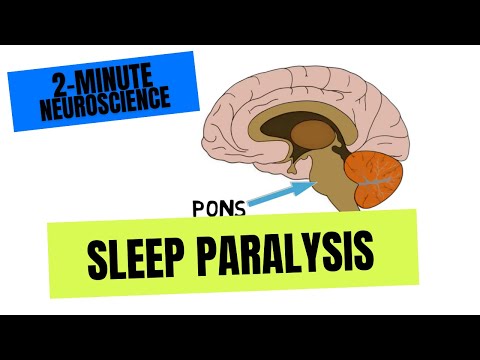
- The brainstem (particularly the pons and medulla) sends inhibitory signals.
- These signals release inhibitory neurotransmitters such as glycine and GABA.
- Glycine inhibition suppresses spinal motor neurons.
- Suppressed motor neurons block signals from the motor cortex to skeletal muscles.
This biological shutdown of voluntary muscles is normal and necessary. However, in REM sleep paralysis, this inhibition persists even after conscious awareness returns.
REM Intrusion Into Wakefulness
Sleep paralysis happens when REM intrusion overlaps with wakefulness. In this state –
- The cerebral cortex becomes alert.
- Conscious awareness returns.
- The body remains under REM atonia.
This mismatch between an awake brain and a paralyzed body creates temporary immobility. The individual experiences a partial awakening, but motor output remains blocked by brainstem inhibition.
This overlap explains how sleep paralysis works at the neurological level – the wakefulness network activates before the REM atonia system shuts off.
Why the Amygdala Triggers Intense Fear
The fear experienced during sleep paralysis has a biological origin. The amygdala, a key structure in the limbic system, regulates fear processing and threat detection.
During REM sleep –
- The amygdala shows heightened activity.
- Emotional memory circuits become highly responsive.
- Fear circuitry becomes more reactive than during normal wakefulness.
When REM intrusion occurs, the amygdala may remain hyperactive. Because the body cannot move and the environment feels dreamlike, the brain interprets the situation as a threat.
This combination produces –
- A sense of presence
- Chest pressure sensations
- Visual or auditory hallucinations
These experiences result from active REM dream imagery combined with heightened limbic system activation.
The Brain During Sleep Paralysis
Brain Structure | Role in Sleep Paralysis |
|---|---|
Brainstem | Initiates REM atonia through inhibitory neural pathways |
Motor Cortex | Attempts voluntary movement, but signals are blocked |
Amygdala | Activates fear circuitry and threat perception |
Limbic System | Amplifies emotional intensity |
Spinal Motor Neurons | Inhibited by glycine, preventing muscle movement |
What Happens During a Sleep Paralysis Episode?
A sleep paralysis episode begins with sudden awareness while the body remains temporarily immobile during REM sleep. The experience unfolds in predictable neurological stages driven by REM sleep intrusion and activation of the sympathetic nervous system.

Sudden Awareness
The episode often starts during a transition –
- Falling asleep (hypnagogia)
- Waking up (hypnopompia)
You become consciously aware of your surroundings. However, your body remains in REM sleep, a stage characterized by muscle atonia.
This partial awakening creates immediate confusion because your mind feels awake while your body does not respond.
Inability to Move or Speak
Temporary immobility is the defining symptom of sleep paralysis.
During REM sleep, the brainstem inhibits voluntary muscle movement. As a result –
- Arms and legs will not move
- Speech is blocked
- Attempts to shout fail
Breathing continues automatically, but it may feel restricted due to shallow REM breathing patterns.
This paralysis typically lasts 20 seconds to 2 minutes.
Chest Pressure and Breathing Sensations
Many people report chest tightness or a feeling of weight pressing down. This sensation occurs because –
- REM sleep reduces activity in large skeletal muscles.
- Breathing shifts to a more automatic pattern.
- The panic response amplifies bodily sensations.
The feeling is uncomfortable but not physically dangerous.
Sleep Hallucinations
Sleep paralysis frequently includes vivid sleep hallucinations caused by REM dream imagery blending with wakefulness.
Common examples include –
- Shadow figures standing nearby
- A sensed presence in the room
- Auditory hallucinations, such as footsteps, whispers, or buzzing
- Tactile sensations like being touched
These hallucinations occur because the brain remains in an active dream state while conscious awareness has returned.
Panic Spike and Sympathetic Activation
The inability to move combined with hallucinations triggers the sympathetic nervous system.
This panic response produces –
- A heart rate spike
- Rapid breathing
- Intense fear
- Sweating
The amygdala amplifies perceived threat signals, even though no real danger exists.
Episode Resolution
A sleep paralysis episode ends when REM atonia stops and full wakefulness returns.
Resolution happens when –
- Brainstem inhibition lifts
- Motor control restores
- Hallucinations cease
Movement returns suddenly, often starting with fingers or toes. The fear subsides once voluntary control resumes.
Sleep Paralysis Symptoms at a Glance
Stage | What You Experience | Biological Cause |
|---|---|---|
Awareness | Sudden awakening | REM intrusion |
Paralysis | Cannot move or speak | Brainstem motor inhibition |
Chest Pressure | Tightness or weight sensation | REM muscle atonia + panic |
Hallucinations | Shadow figures, sounds | Dream state overlap |
Panic Response | Heart rate spike | Sympathetic nervous system activation |
Recovery | Movement returns | REM atonia ends |
Sleep paralysis feels like being awake inside a dreaming body, conscious, unable to move, often frightened, and temporarily trapped in REM sleep.
Although a sleep paralysis attack feels intense, it is a common parasomnia and typically resolves without harm.
Types of Hallucinations in Sleep Paralysis
Sleep paralysis hallucinations fall into 3 primary categories – intruder, incubus, and vestibular-motor hallucinations. These patterns repeat globally because they result from predictable REM intrusion combined with fear circuitry activation.
Researchers consistently classify sleep paralysis hallucinations into these neurological types.

Intruder Hallucinations
Intruder hallucinations involve sensing a threatening presence in the room.
This is the most common category. It typically includes –
- A shadow person standing nearby
- A dark figure in the corner
- A sensed presence watching you
- Visual hallucinations of silhouettes or faces
- Auditory hallucinations, such as footsteps or whispers
Neurological Explanation
Intruder hallucinations occur when –
- REM dream imagery intrudes into wakefulness
- The amygdala activates threat detection
- The brain attempts to interpret immobility as danger
Because the brain’s fear circuitry is active, it generates a threat-focused narrative. The mind converts ambiguous shapes or darkness into human-like figures.
This explains why reports of “sleep paralysis demons” and shadow people appear across cultures.
Incubus Hallucinations
Incubus hallucinations combine chest pressure with a perceived attacker or choking sensation.
Common experiences include –
- A weight pressing on the chest
- A choking sensation
- Difficulty breathing
- A figure sitting on the body
The term “incubus” comes from historical folklore describing a being that “sits upon” the sleeper.
Neurological Explanation
Incubus hallucinations result from –
- REM muscle atonia affecting chest muscles
- Shallow automatic breathing
- Panic-driven amplification of chest tightness
The brain interprets normal REM-related breathing changes as suffocation. The fear response then assigns a visual cause, such as an attacker.
This pattern explains why many cultures describe similar chest-pressing entities despite geographic differences.
Vestibular-Motor Hallucinations
Vestibular-motor hallucinations create movement sensations despite physical paralysis.
Common examples include –
- A floating sensation
- Spinning or falling
- Out-of-body experiences
- Bed shaking or vibration
These episodes feel less threatening and more surreal compared to intruder or incubus types.
Neurological Explanation
Vestibular-motor hallucinations occur when –
- REM motor signals activate internally
- The vestibular system (balance and spatial orientation) misfires
- Motor imagery continues without physical execution
The brain generates the sensation of movement even though muscle output remains blocked.
This REM intrusion explains reports of floating during sleep paralysis.
Why These Patterns Repeat Worldwide
Sleep paralysis hallucinations repeat globally because human brain structures are biologically universal.
The same mechanisms occur in every brain –
- REM intrusion
- Amygdala-driven fear processing
- Brainstem-induced paralysis
- Dream imagery blending with conscious awareness
Cultural beliefs influence interpretation, but the neurological framework remains consistent.
For example –
Hallucination Type | Core Sensation | Neurological Trigger |
|---|---|---|
Intruder | Shadow person or sensed presence | Fear circuitry activation |
Incubus | Chest pressure, choking | REM atonia + panic response |
Vestibular-Motor | Floating, out-of-body experience | Vestibular system disruption |
What Causes Sleep Paralysis?
Sleep paralysis happens when REM sleep becomes disrupted and overlaps with wakefulness, usually due to sleep deprivation, stress, irregular sleep schedules, or neurological conditions like narcolepsy.
The root cause is REM disruption within the normal sleep cycle. Below are the core triggers and risk factors.

Sleep Deprivation
Sleep deprivation is the most common trigger of sleep paralysis.
When you consistently sleep fewer than 6-7 hours per night –
- REM cycles become unstable
- Sleep becomes fragmented
- REM rebound increases the intensity of REM episodes
This instability increases the chance of REM intrusion, where muscle atonia continues into wakefulness.
People with insomnia experience higher rates of fragmented sleep, which directly increases sleep paralysis episodes.
Irregular Sleep Schedule
An irregular bedtime disrupts circadian rhythm and increases REM misalignment.
Shift work, late-night screen exposure, or frequently changing sleep times cause –
- Circadian rhythm desynchronization
- Inconsistent REM timing
- Increased partial awakenings
When REM sleep occurs at unpredictable times, the brain is more likely to wake before muscle atonia shuts off.
Stress and Anxiety
Chronic stress increases cortisol release, which destabilizes REM sleep.
High-stress levels activate the sympathetic nervous system and –
- Increase nighttime awakenings
- Intensify dream vividness
- Heighten amygdala activity
People with an anxiety disorder show increased REM density and emotional reactivity, both of which contribute to sleep paralysis.
Stress does not directly cause paralysis, it increases REM fragmentation, which raises risk.
Trauma and PTSD
PTSD significantly increases sleep paralysis risk due to hyperactive fear circuitry and REM instability.
Individuals with post-traumatic stress disorder (PTSD) often experience –
- Nightmares
- REM fragmentation
- Heightened amygdala activation
- Hyperarousal during sleep
This creates repeated REM-wake overlap, which explains the higher prevalence of sleep paralysis in trauma survivors.
Narcolepsy
Narcolepsy is the strongest medical risk factor for recurrent sleep paralysis.
Narcolepsy is a neurological disorder that disrupts REM regulation. It causes –
- Sudden REM onset during the day
- Cataplexy (sudden muscle weakness)
- Frequent REM intrusion
Because REM control is unstable, people with narcolepsy experience sleep paralysis more frequently than the general population.
Major Sleep Paralysis Risk Factors at a Glance
Cause | Mechanism | Risk Level |
|---|---|---|
Sleep Deprivation | REM rebound and fragmentation | High |
Irregular Sleep Schedule | Circadian rhythm disruption | High |
Chronic Stress | Cortisol release + REM instability | Moderate-High |
PTSD | Hyperactive fear circuitry | High |
Narcolepsy | REM regulation failure | Very High |
Insomnia | Fragmented sleep cycles | Moderate |
Why Does Sleep Paralysis Happen?
Sleep paralysis happens when REM muscle atonia continues into conscious awareness due to sleep cycle disruption.
The underlying pattern remains consistent –
- REM sleep activates.
- Muscle atonia begins.
- The brain partially awakens.
- Motor control remains blocked.
Triggers such as chronic stress, irregular bedtime habits, and neurological disorders increase the probability of this overlap.
Sleep paralysis is caused by REM disruption combined with sleep instability, not by external forces or psychological weakness.
Improving sleep consistency, reducing chronic stress, and treating underlying conditions like narcolepsy significantly reduces episode frequency.
Who Gets Sleep Paralysis?
Sleep paralysis affects approximately 20-30% of the general population at least once in their lifetime, with the highest prevalence among young adults, students, shift workers, and individuals with anxiety or depression.
Multiple epidemiological studies confirm that certain demographics experience significantly higher rates due to sleep disruption and mental health factors.

Sleep Paralysis Statistics and Prevalence
Research data shows –
- 7-8% of the general population experiences recurrent episodes
- 28-32% of college students report at least one episode
- 30-35% of psychiatric patients report episodes
- Onset most commonly occurs between ages 14 and 30
A 2011 systematic review published in Sleep Medicine Reviews (Sharpless and Barber) analyzed 36 studies and found a lifetime prevalence of 7.6% in the general population, rising sharply in students and psychiatric groups.
College Students and Young Adults
College students have one of the highest documented rates of sleep paralysis.
Key contributing factors –
- Late-night studying
- Irregular bedtime schedules
- Chronic sleep deprivation
- Academic stress
Young adults frequently experience disrupted circadian rhythm, which increases REM instability.
Shift Workers
Shift workers face elevated risk due to rotating shifts and circadian misalignment.
People with shift work disorder often experience –
- Fragmented sleep
- REM timing disruption
- Chronic fatigue
Rotating night shifts destabilize the sleep cycle, increasing REM intrusion into wakefulness.
People With Anxiety or Depression
Anxiety disorder and depression significantly increase sleep paralysis frequency.
Clinical studies show –
- Higher REM density in depression
- Increased nighttime awakenings
- Hyperactive amygdala response
- Greater emotional intensity during REM
Chronic stress and mood disorders disrupt sleep architecture, raising risk.
Individuals With Chronic Sleep Deprivation
Sleep deprivation directly increases sleep paralysis episodes by destabilizing REM sleep.
People sleeping fewer than 6 hours per night show –
- Increased REM rebound
- More partial awakenings
- Higher sympathetic activation
This pattern makes REM-wake overlap more likely.
Genetic Factors
Family history increases susceptibility to sleep paralysis.
Twin studies suggest a genetic component influencing –
- REM regulation
- Circadian rhythm timing
- Fear processing sensitivity
Although no single gene causes sleep paralysis, inherited sleep traits increase vulnerability.
Sleep Paralysis Age Group Breakdown
Group | Estimated Prevalence | Primary Risk Factor |
|---|---|---|
General Population | 7-8% recurrent | Sleep disruption |
College Students | 28-32% lifetime | Irregular sleep + stress |
Psychiatric Patients | 30-35% | Anxiety, depression |
Shift Workers | Elevated (varies by schedule) | Rotating shifts |
Ages 14-30 | Highest onset window | Circadian instability |
How Common Is Sleep Paralysis?
Sleep paralysis is common, especially among young adults and individuals with disrupted sleep patterns.
The strongest predictors are –
- Sleep deprivation
- Disrupted circadian rhythm
- Anxiety or depression
- Rotating shift schedules
Consistent sleep timing and mental health management significantly reduce risk in high-prevalence groups.
Is Sleep Paralysis Dangerous?
Sleep paralysis is not physically dangerous and cannot kill you. It is a benign condition classified as a parasomnia, and episodes are temporary.
Although the experience feels intense, it does not stop breathing, cause heart failure, or produce physical injury.

Can Sleep Paralysis Kill You?
No, sleep paralysis cannot kill you.
During an episode –
- Breathing continues automatically
- The heart keeps beating normally
- Oxygen levels remain stable
The sensation of suffocation results from normal REM-related muscle relaxation combined with anxiety, not from actual airway blockage.
Why It Feels Dangerous
Sleep paralysis activates the same systems involved in a panic attack.
During an episode –
- The amygdala triggers a fear spike
- The sympathetic nervous system increases heart rate
- Breathing feels restricted
- Chest tightness intensifies
This produces a powerful breathing difficulty sensation, even though airflow remains intact.
The brain misinterprets immobility as a threat, which amplifies panic.
Is Sleep Paralysis Normal?
Yes, occasional sleep paralysis is normal.
Studies show –
- 20-30% of people experience at least one episode
- Most episodes last 20 seconds to 2 minutes
- Many people have only one or two lifetime occurrences
Because it occurs during REM transitions, it fits within normal sleep physiology.
When Sleep Paralysis May Indicate Another Disorder
Recurring episodes or severe distress may signal an underlying sleep disorder.
Medical evaluation is recommended if –
- Episodes occur multiple times per month
- Daytime sleepiness is excessive
- Sudden muscle weakness (cataplexy) occurs
- Hallucinations persist outside sleep transitions
Frequent episodes may be associated with –
- Narcolepsy
- Chronic insomnia
- Anxiety disorders
- PTSD
In these cases, sleep paralysis is a symptom of broader REM dysregulation.
Sleep Paralysis Health Risks at a Glance
Concern | Reality |
|---|---|
Physical harm | None |
Breathing stops | No |
Heart stops | No |
Psychological distress | Possible during episode |
Long-term damage | None in isolated cases |
Sleep paralysis is a short-lived parasomnia reduces fear. If episodes become frequent or severely disruptive to mental health, consult a healthcare professional to evaluate underlying sleep disorders.
Cultural and Historical Interpretations of Sleep Paralysis
Across cultures, sleep paralysis was historically interpreted as a supernatural attack, but modern science explains it as REM intrusion combined with fear activation.
Before neuroscience identified REM sleep and muscle atonia, people explained the experience using folklore, demons, and spiritual beliefs.

The “Old Hag” (Newfoundland Tradition)
The “Old Hag” is a folklore explanation describing a witch-like figure sitting on the sleeper’s chest.
In Newfoundland and parts of Canada, people described –
- A crushing chest weight
- A shadow entity in the room
- Inability to move or scream
The phrase “hag-ridden” originated from this belief.
Scientific Explanation
The “Old Hag” matches the modern definition of an incubus hallucination –
- REM muscle atonia causes chest pressure
- Fear circuitry generates a threatening presence
- Dream imagery overlaps with wakefulness
The neurological pattern is consistent, even though the cultural label differs.
Medieval Incubus and Succubus Beliefs
In medieval Europe, sleep paralysis was attributed to incubi and succubi, supernatural beings believed to assault sleepers.
An incubus was described as a male demon sitting on the chest. A succubus was described as a female spirit seducing or draining energy.
Commonly reported features included –
- Choking sensation
- Pressure on the body
- Sexualized hallucinations
- Perceived physical restraint
Scientific Explanation
These experiences correspond to –
- REM atonia
- Heightened limbic system activation
- Dream-state hallucinations
The brain constructs culturally familiar figures to explain unexplained paralysis.
Night Demons and Spirit Possession (Global Beliefs)
Many cultures describe similar entities –
Culture | Entity Description | Core Experience |
|---|---|---|
Japan | Kanashibari | Paralyzing spirit |
Brazil | Pisadeira | Old woman stepping on chest |
Turkey | Karabasan | Dark shadow attacker |
Cambodia | Ghost attack | Spirit pressing body |
Despite geographic separation, the reports include –
- A night demon or spirit
- Spirit possession themes
- A sensed presence
- Chest compression
- Fear spike
The repeated pattern suggests a shared neurological origin.
Why Do Cultures Describe Similar Entities?
Cultures describe similar sleep paralysis demons because human brain structures are biologically universal.
Three mechanisms remain constant worldwide –
- REM muscle atonia
- Amygdala-driven fear activation
- Dream imagery blending with wakefulness
The brain searches for meaning during a threat response. It fills gaps using cultural symbolism, religious beliefs, or local myths.
In medieval societies, that symbol was a demon. In modern societies, it may be called a “shadow person.”
The neurological event remains identical.
Folklore vs. Modern Science
Folklore Interpretation | Modern Explanation |
|---|---|
Demon attack | REM intrusion |
Spirit possession | Dream-state overlap |
Old Hag sitting on chest | REM atonia + panic |
Supernatural restraint | Brainstem motor inhibition |
What Is a “Sleep Paralysis Demon”?
A sleep paralysis demon is a cultural interpretation of intruder hallucinations caused by REM intrusion and fear circuitry activation.
Scientific evidence confirms that these experiences originate in the brain, not from external supernatural forces.
Sleep Paralysis vs. Other Sleep Disorders
Sleep paralysis is a brief REM-related parasomnia involving temporary immobility with awareness, while disorders like narcolepsy, night terrors, REM sleep behavior disorder, and epilepsy involve different neurological mechanisms.

Sleep Paralysis vs. Narcolepsy
Narcolepsy is a chronic neurological disorder of REM regulation, while sleep paralysis is usually an isolated REM intrusion event.
Key Differences
Feature | Sleep Paralysis | Narcolepsy |
|---|---|---|
Frequency | Occasional episodes | Chronic, recurrent |
Daytime Sleepiness | No (usually) | Severe, daily |
Cataplexy | Absent | Present in Type 1 |
REM Latency | Normal | Shortened |
Cause | REM-wake overlap | Hypocretin deficiency |
Narcolepsy often includes –
- Cataplexy (sudden muscle weakness triggered by emotion)
- Sleep attacks
- Hypnagogic hallucinations
- Recurrent sleep paralysis
A sleep study (polysomnography) followed by a Multiple Sleep Latency Test confirms narcolepsy by measuring shortened REM latency.
Sleep Paralysis vs. Nightmares
Nightmares occur during REM sleep without paralysis upon awakening, while sleep paralysis involves conscious awareness with temporary immobility.
Feature | Sleep Paralysis | Nightmare Disorder |
|---|---|---|
Movement | Cannot move | Full movement after waking |
Awareness | Awake during event | Asleep during dream |
Hallucinations | Occur while awake | Occur during dream |
Fear | Intense | Intense |
In nightmare disorder, distress comes from vivid dreams. In sleep paralysis, distress comes from being awake but immobile.
Sleep Paralysis vs. Night Terrors
Night terrors occur during non-REM sleep and involve confusion and screaming, not conscious paralysis.
Feature | Sleep Paralysis | Night Terrors |
|---|---|---|
Sleep Stage | REM | Deep NREM (Stage 3) |
Awareness | Fully aware | Confused, disoriented |
Age Group | Teens and adults | Common in children |
Memory | Clear recall | Often no recall |
Night terrors involve autonomic arousal, screaming, sweating, rapid heart rate, without dream imagery overlap.
Sleep Paralysis vs. REM Sleep Behavior Disorder (RBD)
REM sleep behavior disorder involves acting out dreams, while sleep paralysis involves inability to move.
Feature | Sleep Paralysis | REM Sleep Behavior Disorder |
|---|---|---|
Muscle Tone | Excessively suppressed | Not suppressed |
Movement | Blocked | Excessive movement |
Risk | Benign | Injury risk possible |
Population | Young adults common | More common in older adults |
RBD results from failure of REM atonia, the opposite mechanism of sleep paralysis.
Sleep Paralysis vs. Epilepsy
Epileptic seizures involve abnormal electrical brain activity, while sleep paralysis does not.
Indicators of possible epilepsy –
- Uncontrolled jerking
- Loss of awareness
- Tongue biting
- Post-episode confusion
Sleep paralysis maintains full conscious awareness and does not involve convulsions.
A neurological evaluation or EEG may be required if seizure activity is suspected.
When Is Testing Required?
A sleep study is recommended when sleep paralysis is frequent, severe, or accompanied by excessive daytime sleepiness or cataplexy.
Testing may include –
- Polysomnography (overnight sleep study)
- REM latency measurement
- Neurological evaluation
- Multiple Sleep Latency Test
Isolated sleep paralysis without daytime symptoms typically does not require testing.
Sleep Disorder Comparison Summary
Condition | Core Mechanism | Main Distinguishing Feature |
|---|---|---|
Sleep Paralysis | REM intrusion | Awake but immobile |
Narcolepsy | REM dysregulation | Cataplexy + sleep attacks |
Nightmare Disorder | Disturbing REM dreams | Movement after waking |
Night Terrors | NREM arousal | Confusion + screaming |
REM Sleep Behavior Disorder | Loss of REM atonia | Acting out dreams |
Epilepsy | Abnormal electrical discharge | Seizures + confusion |
Sleep Paralysis Diagnosis in One Sentence
Sleep paralysis is diagnosed clinically when brief REM-related immobility occurs during sleep-wake transitions without signs of seizure disorder or chronic REM dysregulation.
Accurate differentiation ensures appropriate treatment and prevents unnecessary medical concern.
How to Prevent Sleep Paralysis
The most effective way to prevent sleep paralysis is to stabilize REM sleep through consistent sleep schedules, improved sleep hygiene, stress reduction, and targeted therapy when needed.
Because sleep paralysis results from REM disruption and circadian rhythm instability, prevention focuses on regulating sleep architecture.

Maintain a Consistent Sleep Schedule
Consistent bedtimes and wake times directly regulate circadian rhythm and reduce REM intrusion.
Follow these guidelines –
- Sleep 7-9 hours nightly
- Go to bed and wake up within the same 30-minute window daily
- Avoid rotating sleep patterns
- Limit late-night studying or irregular shifts
Circadian rhythm regulation reduces fragmented sleep and stabilizes REM timing.
Improve Sleep Hygiene
Strong sleep hygiene lowers episode frequency by reducing sleep fragmentation.
Implement these evidence-based practices –
- Keep a dark bedroom (blackout curtains recommended)
- Maintain a temperature between 60-67°F (15-19°C)
- Reduce screen time at least 60 minutes before bed
- Avoid caffeine within 6 hours of bedtime
- Create a consistent bedtime routine
Screen time reduction decreases blue light exposure, which suppresses melatonin and delays REM onset.
Reduce Stress and Cortisol Levels
Stress reduction techniques decrease sympathetic activation and stabilize REM sleep.
Effective methods include –
- Meditation (10-20 minutes daily)
- Breathing exercises such as 4-7-8 breathing
- Progressive muscle relaxation
- Journaling before bed
Chronic stress elevates cortisol, which increases nighttime awakenings and REM fragmentation.
Cognitive Behavioral Therapy (CBT)
Cognitive Behavioral Therapy is the most effective psychological treatment for recurrent sleep paralysis linked to anxiety or insomnia.
CBT helps by –
- Restructuring catastrophic thoughts
- Reducing fear response during episodes
- Improving sleep consistency
- Addressing underlying anxiety disorders
CBT-I (Cognitive Behavioral Therapy for Insomnia) shows strong evidence for improving sleep stability and reducing parasomnias.
Consider Melatonin (If Circadian Rhythm Is Delayed)
Melatonin supplementation may help regulate sleep timing when circadian rhythm is misaligned.
Typical clinical dosing ranges from –
- 0.5 mg to 5 mg, taken 30-90 minutes before bed
Melatonin is most effective for –
- Delayed sleep phase
- Shift work disruption
- Jet lag-related REM instability
Consult a healthcare provider before long-term use.
Sleep Position Awareness
Some individuals report fewer episodes when avoiding supine (back) sleeping.
While evidence is mixed, side-sleeping may reduce –
- Chest pressure sensations
- Hallucination intensity
Prevention Strategies at a Glance
Strategy | Mechanism | Effectiveness Level |
|---|---|---|
Consistent Sleep Schedule | Circadian rhythm regulation | High |
Sleep Hygiene | Reduced fragmentation | High |
Stress Reduction | Lower cortisol + amygdala activity | Moderate-High |
CBT / CBT-I | Cognitive restructuring + sleep stabilization | High (recurrent cases) |
Melatonin | REM timing support | Moderate |
Side Sleeping | Reduced sensory triggers | Variable |
How to Stop Sleep Paralysis Naturally
You can reduce sleep paralysis naturally by stabilizing REM sleep through consistent routines, stress control, and strong sleep hygiene.
Long-term prevention focuses on –
- Regular sleep timing
- Emotional regulation
- Reduced sleep deprivation
- Treating underlying sleep disorders
When sleep becomes stable, REM intrusion decreases, and episodes typically decline in frequency.
What to Do During a Sleep Paralysis Episode
To break a sleep paralysis episode, focus on slow breathing, shift attention to small movements like fingers or eyes, and stay calm until motor control returns.
Because sleep paralysis is temporary and benign, the goal is to activate the parasympathetic nervous system and reduce panic.

Control Your Breathing First
Slow breathing immediately reduces panic and shortens the episode.
Use this simple breathing exercise –
- Inhale through the nose for 4 seconds
- Hold for 4 seconds
- Exhale slowly for 6-8 seconds
This pattern –
- Activates the relaxation response
- Lowers heart rate
- Reduces the fear spike
- Prevents escalation into panic
Breathing remains automatic during sleep paralysis. The sensation of suffocation is not dangerous.
Focus on Small, Precise Movements
Attempt small movements rather than full-body movement.
Large muscles are strongly inhibited during REM atonia, but small muscles may respond sooner.
Start with –
- Finger movement
- Toe wiggling
- Eye movement
- Subtle facial muscle tension
Shifting to micro-movements increases motor cortex activation and helps break REM atonia faster.
Use Mindfulness and Calm Focus
Mindfulness reduces fear amplification by interrupting catastrophic thinking.
Repeat internally –
- “This is temporary.”
- “My body is safe.”
- “It will end soon.”
Grounding techniques help shift attention away from hallucinations –
- Focus on breathing rhythm
- Count slowly from 1 to 10
- Visualize a neutral scene
Calm focus reduces amygdala activation and limits panic escalation.
Avoid Fighting the Paralysis
Struggling intensely increases sympathetic activation and prolongs distress.
Instead of forcing movement –
- Relax muscles
- Maintain steady breathing
- Allow the episode to pass
Sleep paralysis episodes typically last 20 seconds to 2 minutes.
If Hallucinations Occur
If you experience shadow figures or sounds –
- Do not engage with the imagery
- Redirect attention to breathing
- Remind yourself it is REM dream overlap
Hallucinations fade once motor control returns.
Immediate Action Plan
Step | Action | Purpose |
|---|---|---|
1 | Slow breathing | Activate parasympathetic nervous system |
2 | Finger or eye movement | Break REM atonia |
3 | Calm internal reassurance | Reduce panic response |
4 | Stay still if needed | Prevent fear escalation |
5 | Wait for resolution | Episode ends naturally |
How to Wake Up From Sleep Paralysis
You wake up from sleep paralysis when REM atonia ends and full motor control returns.
You can speed recovery by –
- Slowing breathing
- Triggering small movements
- Maintaining panic control
Understanding that the episode is temporary significantly reduces distress and shortens perceived duration.
Frequently Asked Questions About Sleep Paralysis
Sleep paralysis is a temporary REM-related parasomnia that feels real because the brain is awake while dream imagery and fear circuits remain active. Below are evidence-based answers to the most common long-tail questions.

Why Does Sleep Paralysis Feel So Real?
Sleep paralysis feels real because REM dream imagery overlaps with conscious awareness while the amygdala amplifies the fear response.
During REM sleep –
- The brain generates vivid dream imagery
- The amygdala increases emotional intensity
- Sensory areas remain highly active
When wakefulness returns before REM atonia ends, the brain blends dream content with the real environment. This neurological overlap produces lifelike hallucinations.
Why Do People See the Same Shadow Figure?
People report similar shadow figures because human fear circuitry and visual processing systems are biologically universal.
Common elements include –
- A dark silhouette
- A sensed presence
- A figure standing near the bed
The brain interprets paralysis as a threat. The amygdala activates defensive pattern recognition, often generating a human-shaped intruder because the human brain is optimized to detect faces and bodies in low light.
The figure is not external; it is internally generated REM dream content.
Can Sleep Paralysis Happen Every Night?
Nightly sleep paralysis is rare and may indicate an underlying sleep disorder such as narcolepsy.
Occasional episodes are common. However, chronic episodes occurring multiple times per week require evaluation.
Frequent episodes may be linked to –
- Narcolepsy
- Severe insomnia
- Chronic stress
- Irregular circadian rhythm
A sleep specialist can conduct a sleep disorder evaluation if episodes are recurrent and disruptive.
Can You Die From Sleep Paralysis?
No, sleep paralysis cannot cause death.
During an episode –
- Breathing continues automatically
- Heart function remains stable
- Oxygen levels do not drop
The sensation of suffocation results from REM muscle relaxation and anxiety, not actual respiratory failure.
Sleep paralysis is medically classified as a benign parasomnia.
Is Sleep Paralysis Linked to Mental Illness?
Sleep paralysis is not a mental illness, but it is more common in people with anxiety disorders, depression, or PTSD.
The link exists because –
- Mood disorders alter REM sleep patterns
- Anxiety increases amygdala reactivity
- Stress fragments sleep cycles
Sleep paralysis itself does not indicate psychosis or severe psychiatric disease.
However, if hallucinations occur outside sleep transitions, a medical evaluation is necessary.
Is Sleep Paralysis a Sign of Narcolepsy?
Sleep paralysis can be a symptom of narcolepsy, but most people with sleep paralysis do not have narcolepsy.
Narcolepsy typically includes –
- Excessive daytime sleepiness
- Cataplexy
- Shortened REM latency
- Hypnagogic hallucinations
Diagnosis requires formal testing by a sleep specialist.
Sleep Paralysis Myths vs. Facts
Myth | Fact |
|---|---|
It is caused by demons | It is caused by REM intrusion |
You stop breathing | Breathing continues automatically |
It is a mental illness | It is a parasomnia |
It can kill you | It is not physically dangerous |
Only adults experience it | Teens and young adults have the highest rates |
References and Sources
Cleveland Clinic – What is Sleep Paralysis – Causes, Symptoms and Treatment